Quick Note:
My primary practice is executive leadership coaching — you can find that at redwordcoaching.com. This is a separate and distinct offering I feel called to provide:
This is faith-based coaching for faith leaders who need clarity in implementing their pastoral vision, and professionals in the secular world who want to bring the full weight of their faith into their leadership and decision-making.
Faith-Based Leadership Coaching
Leadership is always personal. But some seasons make that undeniable.
A major transition that is reshaping not just your role but your sense of calling. A period of sustained pressure that is testing your values, your identity, and your clarity about what you are actually here to do. A private question about purpose, vocation, and the kind of leader — and person — God is asking you to be.
These are leadership questions. And they deserve a space where faith is not an afterthought but the foundation.
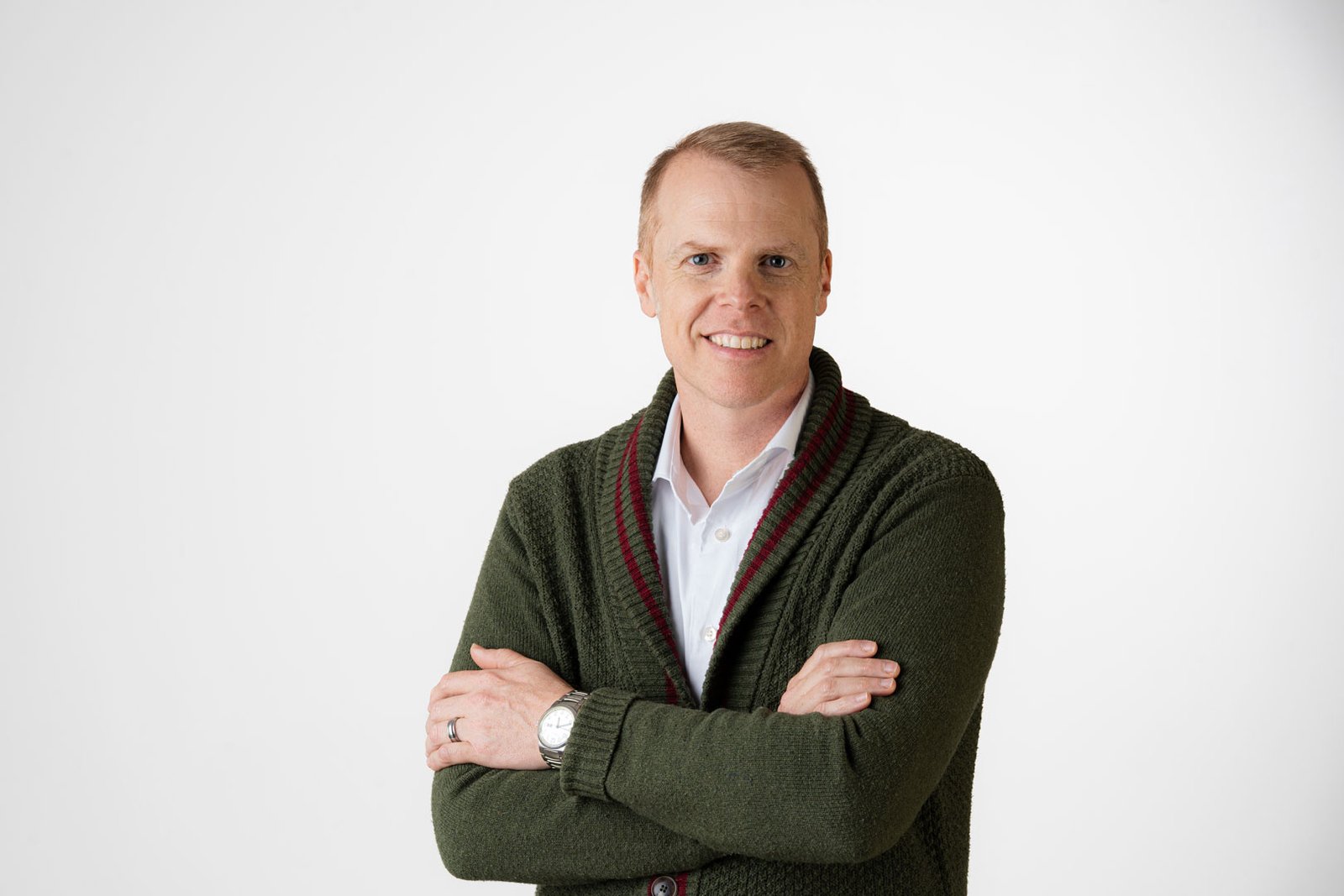
I am Randy Warren — an executive coach, a retired U.S. Army officer, and a Certified Catholic Mindset Coach. My primary practice focuses on senior leaders navigating professional transition, supported by ICF Level 2 coaching training through UC Davis. This page represents an intentional extension of that work — for leaders who want to bring their faith into the room alongside everything else.
You are in the right place.
“Be transformed by the renewing of your mind.”
— Romans 12:2
Prayer and contemplation are essential. But God also gave us the intellect to know the good and choose rightly. This coaching develops that capacity, so you can exercise every gift He has entrusted to your leadership
This Work Serves Two Primary Paths
Executive style coaching grounded in Christian intellectual tradition serves two distinct audiences — and the distinction matters because it shapes both the questions we ask and the terrain we navigate together.
Faith Leaders
pastors, deacons, parish and ministry leaders, or others in positions of responsibility — who need clarity to implement their pastoral vision without turning their ministry into a corporate operation. The work is helping you lead with the strategic rigor that complex institutional and community realities demand, while keeping your pastoral mission as the north star. You need a thinking partner who understands both the executive dimension of your leadership and the spiritual integrity of your calling.
For faith leaders, the work is about maintaining coherence between your vocation and your leadership — making sure the executive capacity serves the pastoral mission, not replaces it.
Executives and Senior Leaders
In any sector, at any level — who want to bring the full weight of their faith into their professional leadership and decision-making. You are building something or leading people in a context where your faith is not separate from your work; it is central to how you think about it. You need a thinking partner who can help you hold both the professional complexity and the spiritual dimension together, without reducing either to the other.
For executives integrating faith, the work is about ensuring your deepest convictions are shaping your decisions, not just decorating them — that your faith is the lens through which you lead, not something you return to when professional tools run out.
The methodology is the same for both -But the application differs because the terrain does.
Both paths require the same rigorous examination of what you’re making your circumstances mean about yourself, your calling, and your leadership. Both require clarity about the difference between facts and interpretation. Both require deliberate choice instead of a reactive response.
If you are navigating significant leadership change — professional, pastoral, or both — and you want to do that work grounded in something deeper than strategy alone, you are in the right place.
This work is for anyone who takes that calling seriously — who wants to lead well in whatever arena they have been given, and who believes that faith should be the foundation of that effort rather than an occasional comfort when everything else fails.
If that is you, you are in the right place.
"Whatever you do, work at it with all your heart, as working for the Lord, not for human masters, since you know that you will receive an inheritance from the Lord as a reward. It is the Lord Christ you are serving."
— Colossians 3:23-24
An Important Note on Faith Tradition
While this work is rooted in the Catholic tradition, the underlying principles — that a life well-lived requires alignment between who we are, what we believe, and how we lead — are not exclusive to any single expression of faith. I have worked with leaders from other Christian traditions, and people of faith across backgrounds who share the conviction that their lives should be ordered toward a higher purpose.
If you are a person of sincere faith — regardless of tradition — who believes that your leadership, your family, and your integrity should be grounded in something greater than yourself, this work may be exactly what you are looking for. Reach out. We can determine together whether there is a fit.
"In essentials, unity; in doubtful things, liberty; in all things, charity."
— Often attributed to St. Augustine
A Word to Those Who Lead the Church
You have given your life to serving others. You carry the weight of your community, your institution, and your own calling — simultaneously, and often alone.
Pastoral leadership is among the most demanding forms of leadership there is. The expectations are total. The scrutiny is constant. The work never fully ends. And unlike most leaders, you navigate all of it within an institution that is itself navigating profound change — culturally, organizationally, and spiritually.
“The good shepherd lays down his life for the sheep.”
— John 10:11
The leader who is coherent only at work is always one personal crisis away from a professional one.
And yet, for all the structures the Church provides — spiritual direction, the sacrament of confession, the authority of your bishop — there is one space that is rarely available to those in pastoral leadership:
A confidential, structured thinking partnership with someone outside your institution who has no agenda, no authority over you, and no role to protect — whose only purpose is to help you think more clearly about the questions you are actually carrying.
That is what coaching provides. Not spiritual direction. Not supervision. Not another layer of accountability. A genuine thinking partnership — professionally rigorous, completely confidential, and grounded in the same faith that called you to lead in the first place.
I work with pastors, deacons, parish leaders, ministry directors, and others in positions of pastoral responsibility who are navigating significant change, carrying significant weight, or asking significant questions about their vocation, their leadership, and who God is asking them to become in this next season.
Coaching and the Church — What’s the Difference?
A pastor already has a spiritual director. A confessor. A hierarchy. A community of brothers. Why would he need a coach?
It is a fair question — and it deserves a direct answer.
Each of those relationships serves a distinct and irreplaceable purpose. Spiritual direction accompanies the interior life and relationship with God. Confession addresses sin and offers absolution. The bishop exercises legitimate authority and pastoral oversight. The fraternity of priestly brotherhood offers solidarity and shared identity.
Coaching serves none of those purposes — and is not trying to. What it does instead is provide a structured, confidential space to examine the thinking, assumptions, and patterns that are shaping your decisions and your leadership. It is not about your soul. It is about your mind — and how your mind is performing under the specific pressures and demands of the leadership role you hold.
A spiritual director accompanies you toward God. A coach helps you think more clearly about everything else — the decisions, the transitions, the stakeholders, the questions of identity and vocation that don’t resolve in prayer alone but require rigorous, honest examination.
These are complementary, not competing. Many of the most effective leaders in the Church already work with coaches — quietly, confidentially, and with significant results. The question is not whether coaching is appropriate for those in pastoral leadership. It is whether the leader is willing to invest in the quality of their own thinking at the level their role demands.
Who This Is For
This coaching is for any person navigating a significant change — professional, personal, or spiritual — who wants to do that work through the lens of their faith. The following describes who finds their way here.
Leadership does not always have a title, a rank, a role, or a position of organizational authority.
In the Catholic tradition, every person is called to lead — because every person is called to love, to witness, and to serve in the specific relationships and circumstances God has placed them in.
This work is for anyone who takes that calling seriously — who wants to lead well in whatever arena they have been given, and who believes that faith should be the foundation of that effort rather than an occasional comfort when everything else fails.
If that is you, you are in the right place.
"Go, therefore, and make disciples of all nations."
— Matthew 28:19
Clergy and Leader of Faith
The Situation
You navigate institutional complexity, community expectations, and your own vocation — simultaneously. You may be facing a significant transition: a new assignment, a difficult community, or you may simply be carrying questions about moving forward.
What We Work On
- Navigating transitions in ministry
- Leading institutional change with clarity
- Burnout prevention and resilience
- Isolation of leadership
- Discernment about living out your vocation
What Success Looks Like
You lead with clarity and conviction rather than reactivity. You bring the full weight of your vocation to your ministry without losing yourself in it. You have a confidential space to think through what leadership demands — and you arrive at decisions that are fully yours, grounded in your own deepest values and sense of calling.
Leaders & Executives Integrating Faith
The Situation
You are navigating significant change — and your faith is not separate from that navigation, it is central to it. You want a thinking partner who can hold both the professional and the spiritual dimensions of your transition together, without reducing one to the other.
What We Work On
- The professional and personal dimensions of transition
- Maintaining your values under pressure
- Discerning what this season is asking of you
- Decision grounded in your convictions
What Success Looks Like
You navigate the transition without losing yourself in it. Your faith is not something you return to when the professional tools run out — it is the lens through which you lead from the beginning.
Parents, Spouses & Family Leaders
The Situation
You are navigating one of life’s most consequential vocations — partnership in marriage and family leadership. You need a rigorous, honest thinking partnership that honors both your interior life and your leadership — not quick fixes.
What We Work On
- Discerning Vocation and identity
- Leading a household through change
- The intersection of professional and family
- Closing the gap between faith and pressure
- Decision grounded in your convictions
What Success Looks Like
Your family experiences you as present, purposeful, and trustworthy. Your leadership flows from clarity about your vocation, not reactivity. The gap between who you’re called to be and who you are is closing — through clarity about what matters. Your faith is the foundation from which everything flows.
The world's definition of leadership is narrow - God's is not!
Leadership does not always have a fancy title, or a position of organizational authority.
In the Catholic tradition, every person is called to lead — because every person is called to love, to witness, and to serve in the specific relationships and circumstances God has placed them in.
This work is for anyone who takes that calling seriously — who wants to lead well in whatever arena they have been given, and who believes that faith should be the foundation of that effort rather than an occasional comfort when everything else fails.
If that is you, you are in the right place.
Not sure if you fit neatly into one of these categories?
If we are not a good fit, I may be able to help you find someone who can
What This Work Is — and What It Isn’t
“Problems yield to technique. People require presence.”
— Gabriel Marcel
Marcel’s distinction cuts to the heart of why faith belongs in this work. A technique can solve a problem. But a person — carrying questions about vocation, identity, purpose, and integrity under pressure — requires something technique alone cannot provide.
But I want to be clear, this is not spiritual direction. It is not pastoral counseling. It is not therapy. Those are distinct vocations requiring different training, different boundaries, and different purposes.
It is executive coaching grounded in Catholic intellectual tradition — a rigorous, faith-grounded process that helps you examine the beliefs, assumptions, and patterns of thinking that are shaping your decisions and your sense of calling. The methodology is non-directive, structured around your goals and obstacles. The difference is that we bring the full resources of Catholic wisdom to that work. Faith is not a backdrop. It is the foundation.
Conscience Formation — Ordering Decisions Toward Human Flourishing
A decision doesn’t just need to be technically sound. It needs to be ordered toward the human flourishing of the people affected — and ultimately, toward God.
Conscience formation is the capacity to discern what love actually requires in your situation. Technical competence and strategy matter. But if your decisions extract value rather than create it, uses people rather than serve them, or prioritize metrics over meaning, you have separated your leadership from your faith. Coaching helps you bring them back together.
To think this way, we draw on Christian wisdom traditions such as:
Prudence — Practical Wisdom. The capacity to discern what this particular situation calls for, grounded in principle, experience, and faith. The difference between reacting and responding.
The Three Fonts of Morality. A way to examine any decision: the object (what you’re doing), the intention (why), and the circumstances (the context). By examining all three, you make decisions that are both effective and ordered toward human flourishing.
Grounded in Ancient Wisdom, Modern Science, and Lived Experience
This work draws on three foundations: St. Thomas Aquinas’s understanding that our thoughts inform our choices, and our choices shape our character—meaning we can examine and change the beliefs driving our leadership. Modern behavioral science, which confirms that patterns of response can be examined and changed. And Church teaching—two thousand years of wisdom on living a fully integrated life in relationship with God and others.
“The things that we love tell us what we are.”
— St. Thomas Aquinas
The deepest questions about vocation, virtue, identity, and purpose require a space where both rigorous thinking and genuine faith operate together. This work draws on all three, informed by a 24-year military career lived through repeated seasons of profound transition.
All conversations are fully confidential.
What the Work Covers
Engagements are tailored to the individual and their specific season of life. The following areas come up most often — sometimes one at a time, more often in combination:
Vocation and Calling
Discerning God’s invitation in this specific season of your life.
Transitions and Change
Carrying your faith as an anchor through professional, personal, and spiritual disruption.
“Jesus Christ is the same yesterday and today and forever.” — Hebrews 13:8
Moral Decision-Making
Navigating complex choices through rigorous ethical reasoning grounded in faith.
Identity, Virtue and Coherence
Developing the habits that define who you are while closing the gap between who you are called to be and how you live.
“We are what we repeatedly do…”
— Aristotle – cited by Aquinas
Leadership in the Domestic Church
Leading your family with purpose, presence, and authentic love.
“As the family goes, so goes the nation, and so goes the whole world in which the family lives.” — Pope John Paul II
Resilience Under Pressure
How It Works
Prayer is always the starting point
Goals & Obstacles
Every session begins here
What are you actually trying to accomplish? And what is standing between you and that outcome? Pastoral leaders and faith-centered executives often arrive with a presenting problem that isn’t the real problem. Anchoring the conversation in the specific goal and the specific obstacle clears the noise and identifies the actual work.
Situation
What Is Actually Happening?
We establish the facts — stripped of interpretation. What is the situation, specifically? Not what it feels like, not what it might mean, not what you’re making it mean about yourself or your calling. What is actually, verifiably true about the circumstances in front of you?
Under pressure, facts and interpretations collapse together. Separating them is the first act of clear leadership thinking — and it’s the foundation for everything that follows.
Interpretation
What Are You Making This Mean?
This is the leverage point. An obstacle is a fact. What a leader makes that obstacle mean — about their capability, their vocation, their identity, their standing before God and their community, their organization’s capacity to fulfill its mission — is interpretation. And interpretation drives response far more than the facts do.
Interpretations, unlike facts, can be examined, challenged, and changed. That is where the real leadership leverage lives.
Response
What Is the Deliberate Choice?
Once the situation is clear and the interpretation has been examined, the response changes. Not because the facts changed — but because the leader is no longer responding to their interpretation of the situation. They are responding to the situation itself.
The difference between a reactive leader and a deliberate one is almost always located here.
Why interpretation is the work most coaches skip
Most executive coaching works at the level of behavior and strategy — what to do differently, how to communicate more effectively, what actions to take. That is useful. But it operates on the surface of the problem. A leader who hasn’t examined what they are making their situation mean will still make reactive, identity-driven decisions when the pressure compounds — no matter how good the plan. The SIR framework addresses the layer beneath behavior — because that is where decision quality is actually determined.
Every engagement begins with a complimentary discovery conversation — 30 minutes, no obligation, fully confidential — to explore where you are, hear how I work, and determine whether there is a genuine fit.
Why I Do This Work
As a husband, a father of three, and a man who has moved his family across six countries over 24 years of military service — I know this struggle from the inside. I have carried the questions of vocation, identity, and calling that no leadership framework was built to answer. I began this work because I needed it myself, and what I found was that when faith becomes the foundation rather than an afterthought, everything changes. Not the circumstances. The clarity. That is what I want to help you find.
I live a short drive from Fátima, Portugal — one of the most spiritually significant places in the Catholic world — with my wife Claire and our three children. Over the years I have served my faith community in a number of roles: as an RCIA teacher, a Religious Education instructor, a Youth Minister, and a Youth Sports Coach. I am a member of the Communion of Catholic Coaches and Metanoia Catholic Coaches, and I am currently pursuing a Master’s degree in Pastoral Theology.
I bring all of that to this work — not as credentials to impress, but as evidence that I take these questions seriously at every level of my life. This is not a side offering. It is a calling.
“Go forth and set the world on fire.”
— St. Ignatius of Loyola
“The leader who is coherent only at work is always one personal crisis away from a professional one.”
A Life Lived in Transition
Twenty-four years of service. Six countries. Military deployments. Time apart. Three kids who learned how to say goodbye and hello in more languages than most people ever need.
And through all of it — Claire. A woman who packed up a life, over and over, with a grace I still cannot fully explain. Who built something warm and familiar in places that had no roots yet. Who held our family together through the kind of upheaval that breaks most secular marriages — and somehow made each new place feel like home before the boxes were even unpacked. Our children are who they are in large part because of her. I do this work because I have seen up close, what it looks like when a family is grounded in something that doesn’t move.
These are some of the places and moments that shaped the man I am and the work I do now.
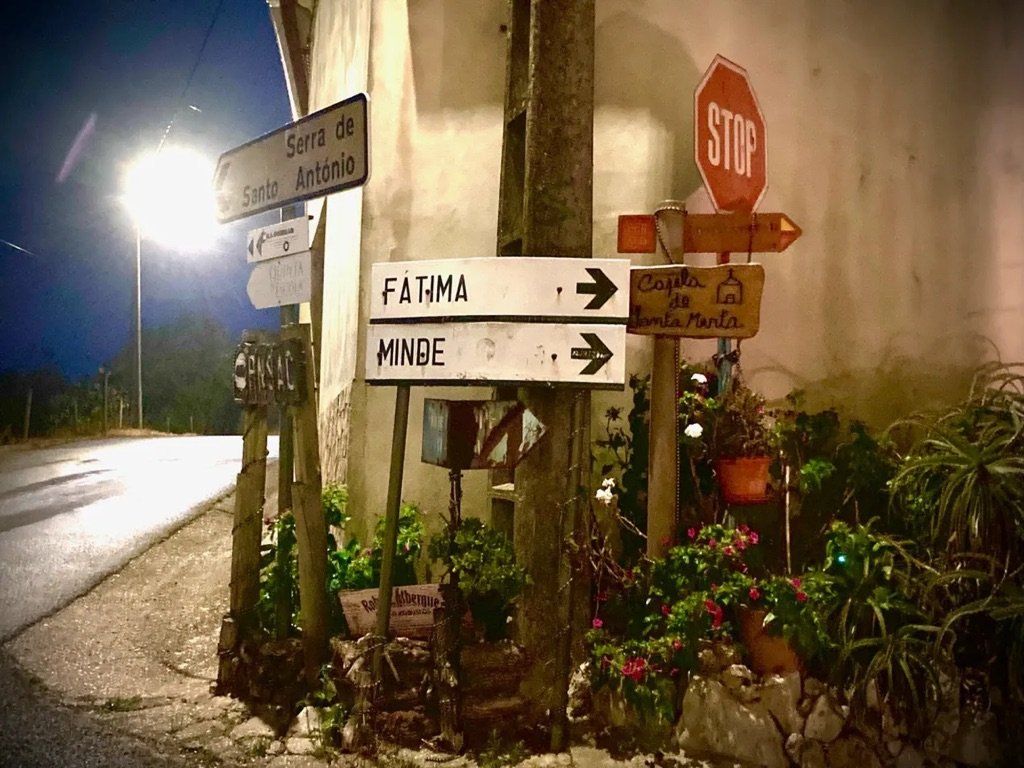
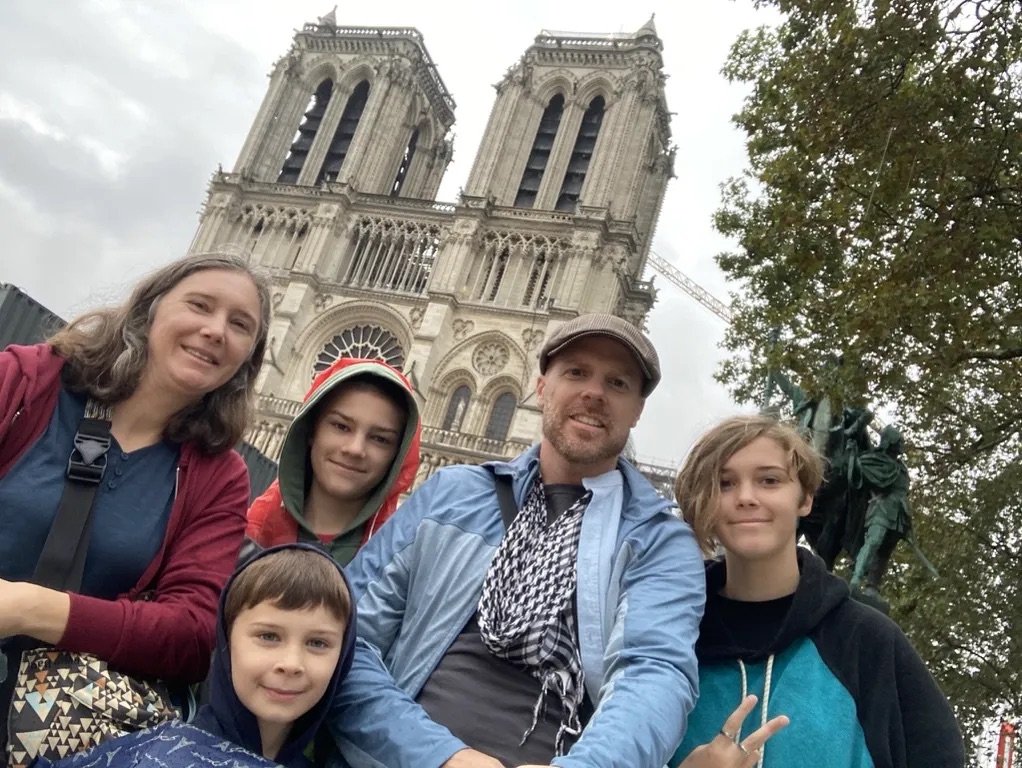
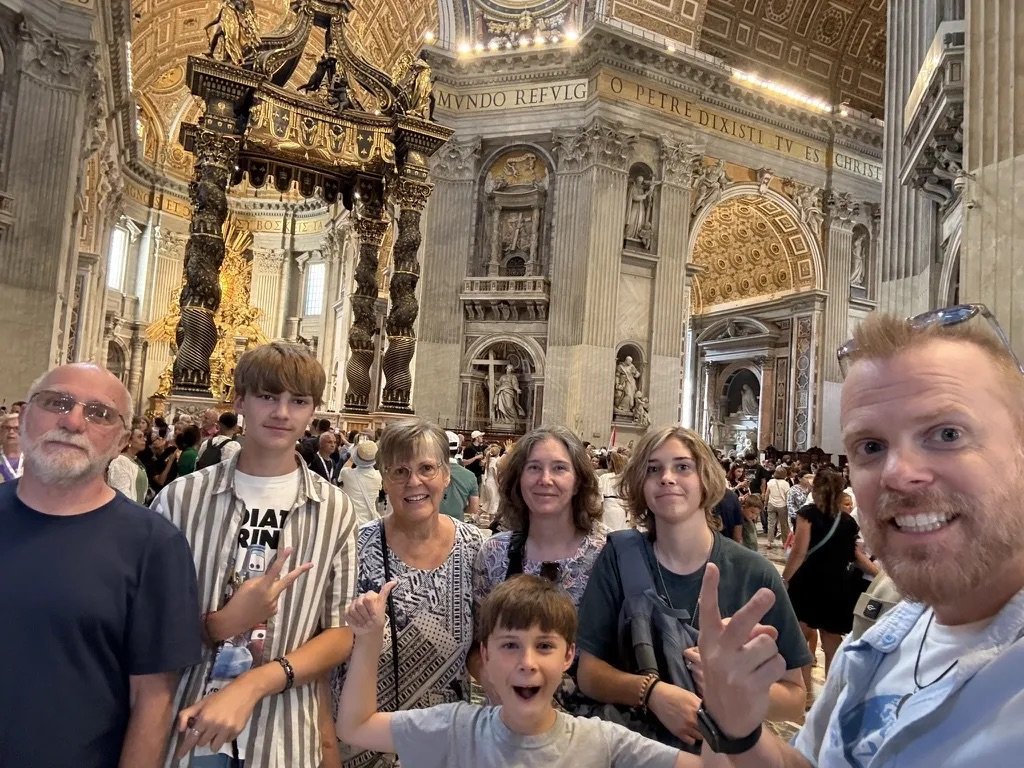
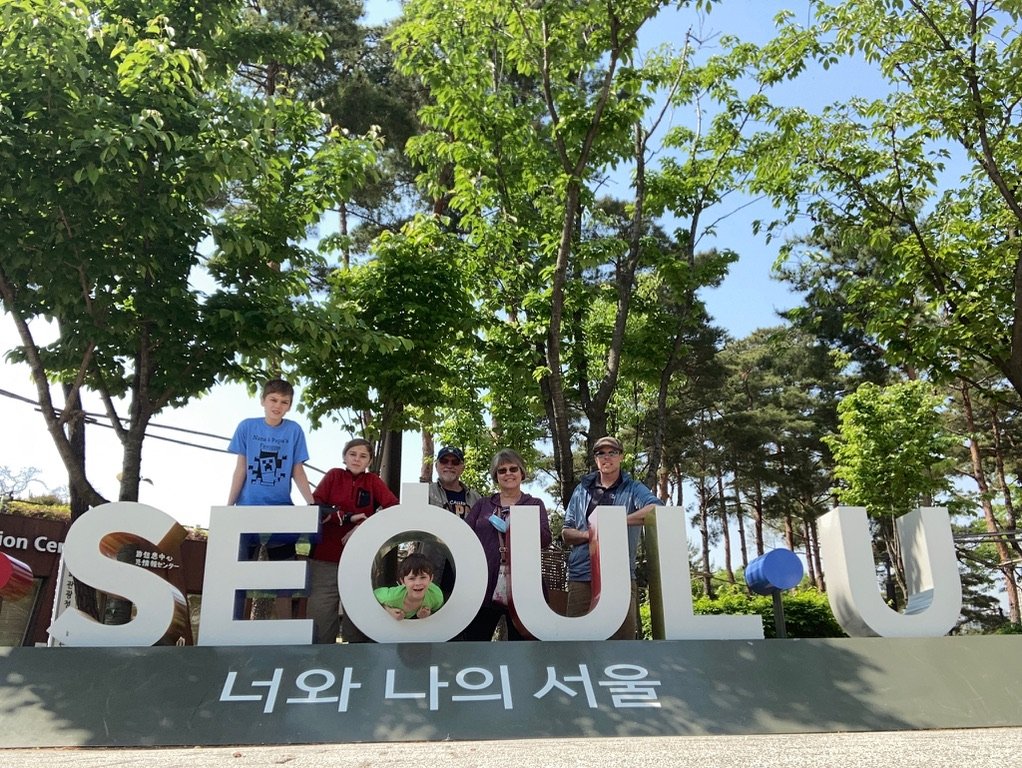
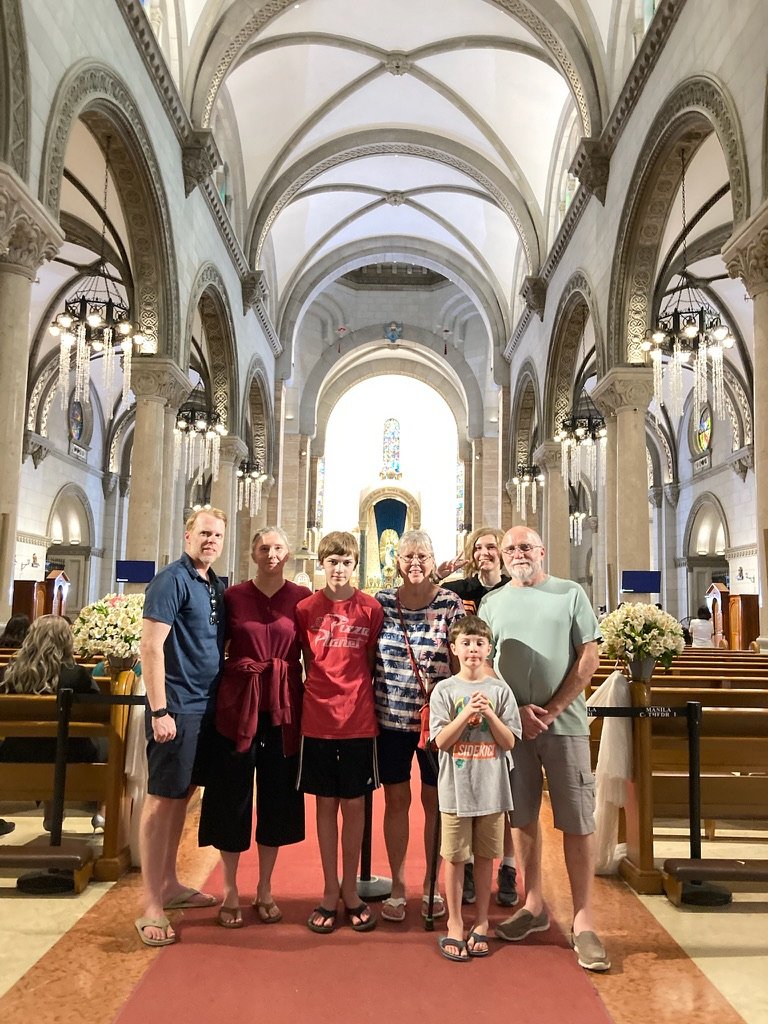
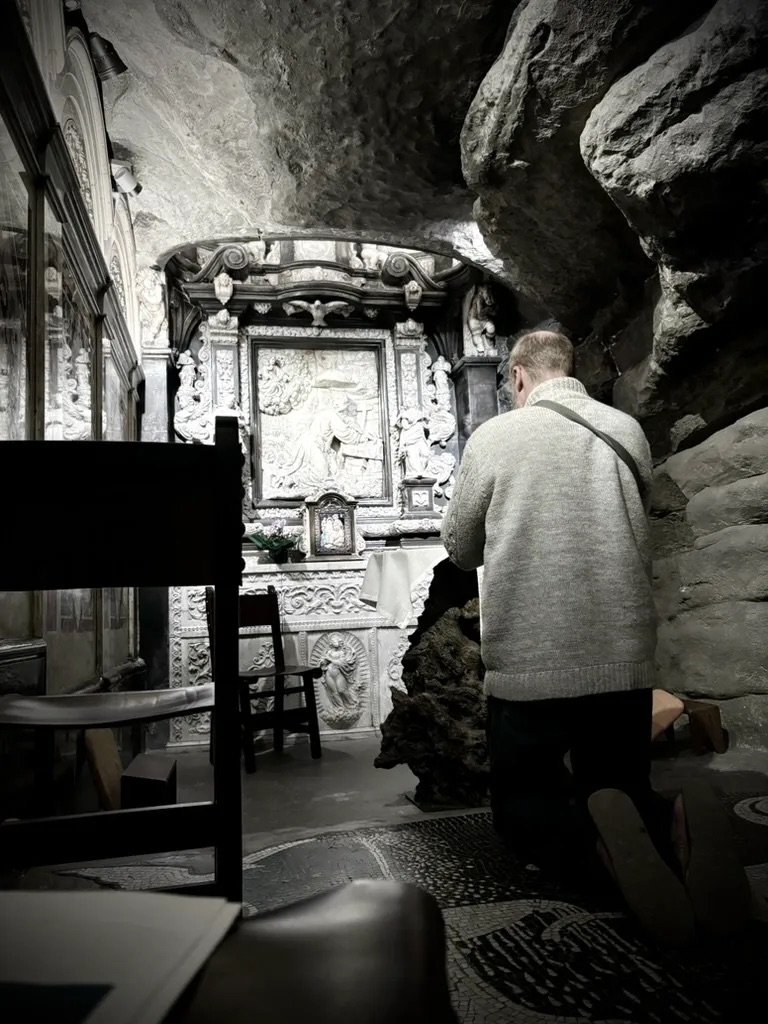
A few hours in the cave where Ignatius began. Some questions are only answered on your knees.
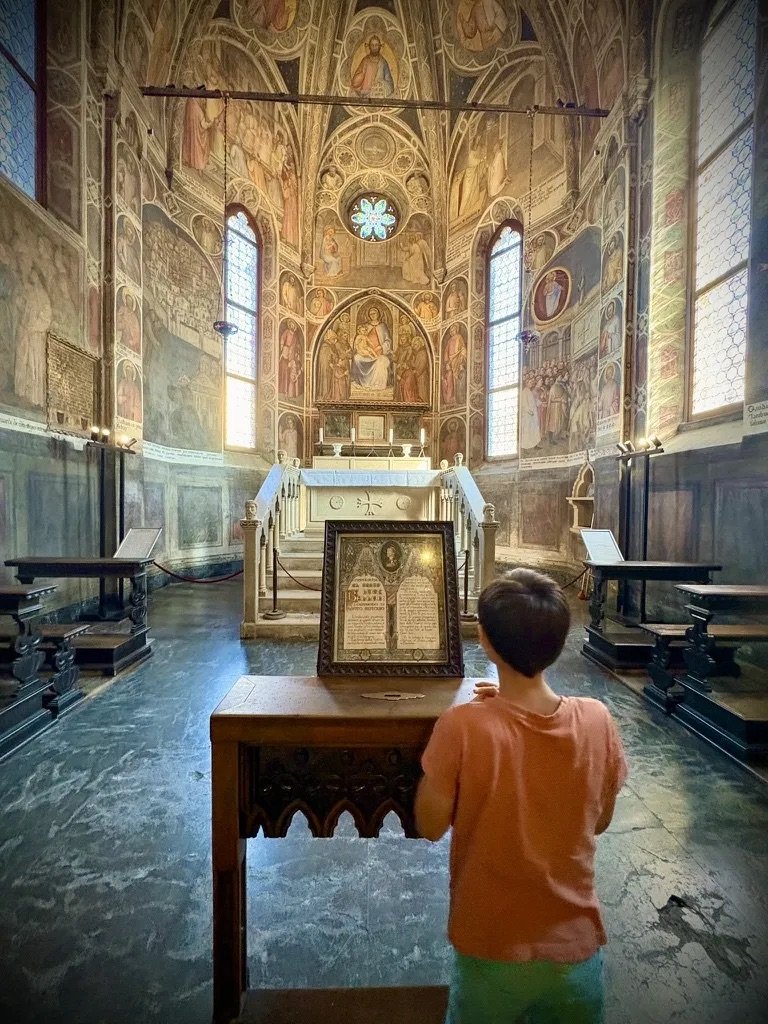
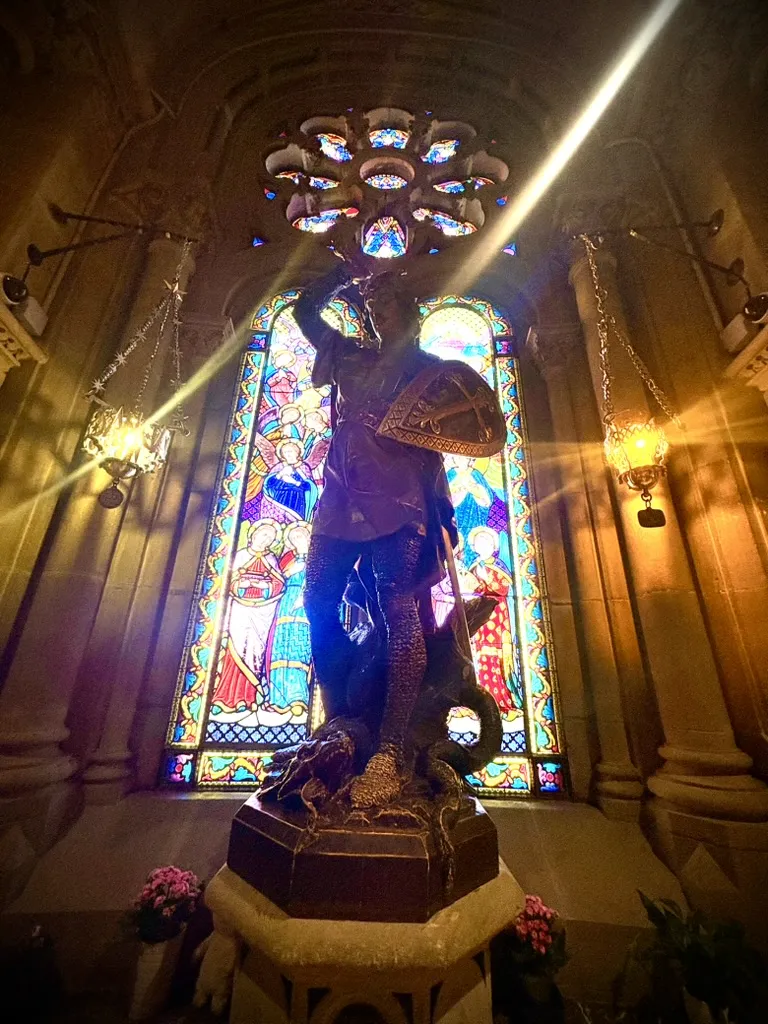
We have been to a lot of churches. Some of them are beyond words.
If you want to know why I do this work, these photos are a better answer than any credential.
Why “Red Word”?
The name has two meanings — and on this page, both matter.
In early literacy, red words are the words that defy the rules. They cannot be decoded phonetically and must be learned through deliberate, repeated practice. Every child encounters them. Only focused effort makes them second nature.
Leadership has red words too — the non-intuitive elements that no training program automatically produces. The judgment to act without certainty. The humility to lead without imposing. The courage to hold your standard when the pressure to compromise it is highest. The wisdom to know when to act and when to wait. These are not learned in a classroom. They are forged through experience, reflection, and the willingness to examine your own assumptions under pressure.
But there is a second meaning. In many editions of the Bible, the words of Jesus Christ are printed in red — set apart from the rest of the text as the direct voice of God made man. Those words are the ultimate foundation of this work. Not as decoration. Not as inspiration. As the actual Rules of Engagement for a life lived with integrity, purpose, and love.
“I am the way, the truth, and the life.”
— John 14:6
Background & Credentials
Randy Warren is an Executive Coach, a Certified Catholic Mindset Coach, a husband and father of three, a combat veteran, a retired U.S. Army officer, with multiple advanced degrees and most of all a man who has lived the questions of vocation, leadership, and identity across 24 years of service in six countries. He brings all of it to this work.
Faith & Coaching Credentials
- Certified Metanoia Mission Coach
- Certified Catholic Mindset Coach
- Member: Communion of Catholic Coaches
- Member: Metanoia Catholic Coaches
- ICF Level 2-accredited Coach - UC Davis (Currently Enrolled)
Education
- Master’s degree candidate in Pastoral Theology
- Master’s in Leadership & Operational Studies
- Master’s in Education Administration
- Bachelor’s degree in Psychology
- Strategic Studies Fellowship — UNC Chapel Hill
Military & Leadership Experience
The following represents a small selection from a 24-year career spanning nine career fields, six countries, and every level of organizational leadership. Full history available upon request.
- 24 years U.S. Army — Senior Leader - Combat Veteran
- Senior Director, Workforce Strategy & People Operations (35,000 personnel
- Organizational turnaround: 49th to 6th globally
- 600% increase in program enrollment within a year
- University Associate Professor - Leadership and Military Science
Faith Community Service
The following are some of the leadership focused Faith and Community roles held through the years that have shape how I lead inside and outside the Church and how I now help others do the same.
- RCIA Teacher & Religious Education Instructor
- Youth Minister
- Youth Sports Coach & Boy Scouts of America Leader
- Parish Pastoral Council
- Member of Catholic Military Apostolate & Knights of Columbus
- International Director CMA-USA
Randy now lives on Portugal's Silver Coast with his wife Claire, their three children, and their mini-labradoodle.
Confidential Discovery Call
"Be who God meant you to be and you will set the world on fire.”
— Attributed to St. Catherine of Siena
A complimentary 30-minute conversation — confidential, no obligation — to explore where you are and whether this work is the right fit.
Prefer to Reach Out Directly?
Get in Touch
Reaching out is not a commitment. It is a conversation. Everything discussed is confidential.
Location
Portugal’s Silver Coast
Serving leaders worldwide through virtual coaching engagements.
Testimonials
Want to hear what other leaders have said about me? View my LinkedIn recommendations.
Confidential Discovery Call
Still Have Questions? Let’s talk.
Faith-Based
Leadership Coaching
-
Contact Information - +1 (989) 200-8580
- +44 7537 180716
- RandyWarren@RedWordCoaching.com
- www.linkedin.com/in/rd-warren
Red Word Coaching — Executive Coaching
Portugal’s Silver Coast • Serving leaders across all major time zones